
Compare Columbia County Property Values
No single figure means "what a property is worth" across every Columbia County record. Municipal assessors maintain the parcel assessments. Wisconsin DOR publishes equalized values at the municipality level. Recorded instruments, meanwhile, reflect one conveyance at a time. Read the label, the year, the parcel, and the source together before lining one number up against another.
| Value | What It Is | Where |
|---|---|---|
| Assessed value | Local value assigned to a parcel for the assessment roll. | Municipal assessor / parcel record. |
| Equalized value | State measure used to compare value levels among municipalities. | Wisconsin Department of Revenue reports. |
| Market value | Estimated exchange value under the applicable assessment standard. | Valuation framework and assessor work. |
| Sale consideration | Amount associated with a recorded conveyance when reported. | Transfer return or deed record. |
An assessed value feeds the tax assessment process. A sale price belongs to one transaction. A market estimate is a third measure, answering a different question entirely. Even a tax bill is not a property value, since taxing districts and other factors shape the final amount. The tax page covers bills and the review process. Here the focus stays on what each number actually means.
Open a Columbia County Value Record
Ascent is the county's public search. It leads to a parcel's land and tax details. A result table shows the parcel, the owner or owners, and the site address. It also lists a privacy expiration date and the tax years. The table does not display every value field on its own, though. Open the live parcel record. Read its current labels, year, and detail options before copying any amount into a comparison.
| Parcel | Use it to confirm the exact property record. |
|---|---|
| Owner(s) | Administrative owner name shown with the parcel. |
| Site address | Physical location associated with the parcel. |
| Tax years | Years available for bill detail, not sale dates. |
The public Ascent Land Records search is where to begin a parcel-value lookup.
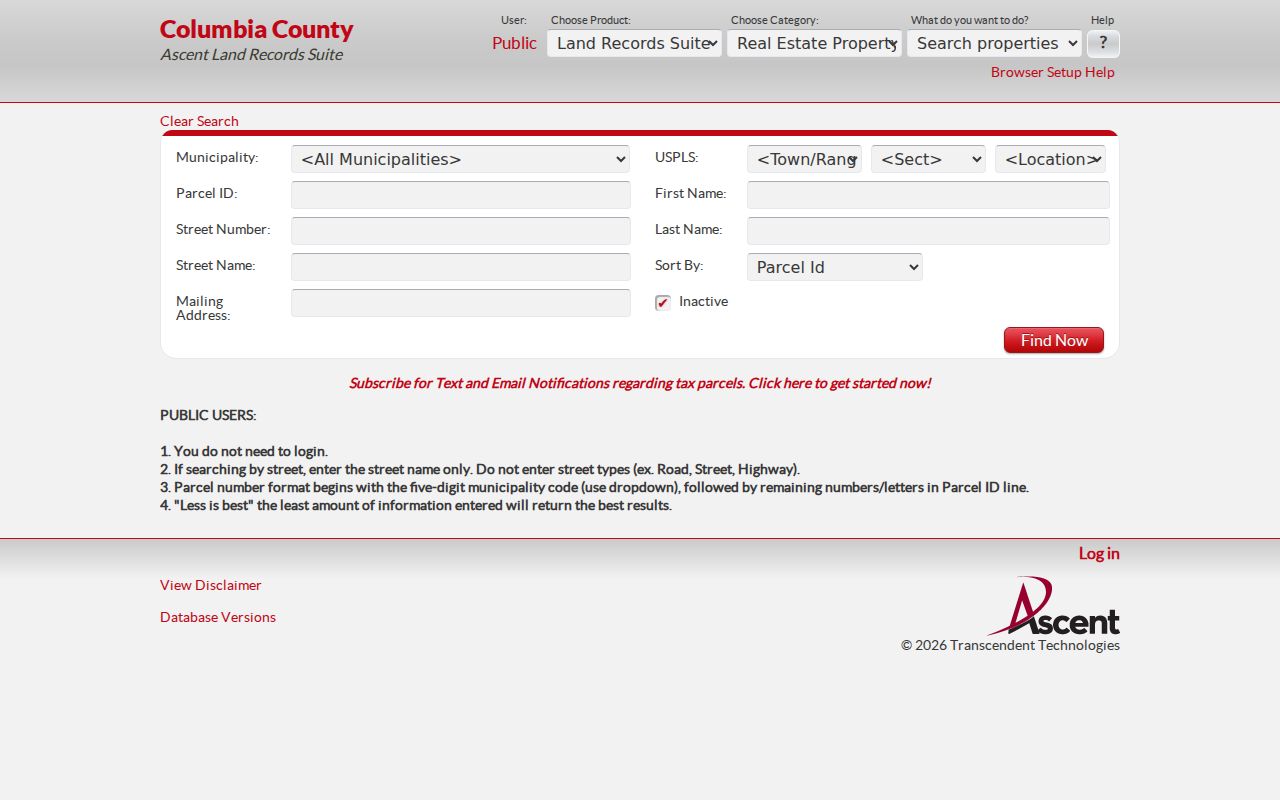
The search form is only the entry point. To see the assessed-value labels that apply, open the live parcel detail.
Find a Columbia County Assessed Value
Ascent Land Records serves as the countywide entry point for parcel and tax information. Municipal assessors handle the actual assessment work. Search by address or parcel number, confirm the municipality, and open the parcel detail to see the current assessment information for that record. Not every page presents the same field breakdown. Read the live field labels rather than assuming a fixed card layout.
- Search Ascent by address or parcel and confirm the municipality and site address.
- Open the parcel detail and record the value labels and assessment year displayed.
- Check the deed or electronic transfer return for the consideration associated with a recorded sale.
- Use Wisconsin DOR equalized-value reports only for municipal comparison, not as a parcel appraisal.
- Assessed value
- The local assessor's value entry for a parcel on the assessment roll.
- Equalized value
- A Wisconsin DOR figure used to compare municipal value levels.
- Sale consideration
- The amount reported with a particular conveyance, when applicable.
- Level of assessment
- A ratio comparing assessed value with an estimated full value measure.
Columbia County January First Valuation
Wisconsin Department of Revenue guidance sets January 1 as the valuation date for the assessment year. That makes the date on a value record essential. A later sale may reflect a different market moment. The assessor's figure, by contrast, applies the relevant standard and the information available for that assessment cycle. Same parcel, two snapshots, two meanings.
DOR guidance also says sales should be checked for usability before entering assessment work. One conveyance can carry conditions that simply do not fit another property. The deed alone may not explain every factor. Compare the parcel, the date, and the documented terms before drawing any conclusion from a single sale.
Read Columbia County Ratios in Context
The assessment ratio compares assessed values against a full-value estimate. Wisconsin's equalized-value process supports comparisons among municipalities. It does not provide a parcel appraisal. A Columbia County owner should identify the property's municipality and assessment year before relying on a statewide report. A municipality-level ratio describes a broad pattern rather than the value of one house or lot.
The Department of Revenue's assessment guidance explains how equalized values are used. Its annual reports cover assessment levels too. Keep that state comparison separate from the parcel value on the local assessment record. Wisconsin's assessment manual describes equalized value and the broader valuation framework in depth.
Columbia County's Five-Year Rule
Wisconsin's major-class rule applies a five-year compliance test with a 10 percent threshold. It concerns assessment maintenance for a property class at the municipal level. It is not a promise that every parcel gets revalued on a fixed five-year schedule. The rule helps explain a common gap. Local assessed values and the state's equalized-value measure can move differently over time.
For a Columbia County parcel, the local assessor remains the source. That office handles the property-level assessment and its roll year. The County Land Information Department coordinates parcel and assessment data countywide. Local assessors run open-book sessions and Board of Review work. The county publishes no single countywide revaluation year. Rely on your municipality's current notice for that detail. Wisconsin DOR's major-class guidance explains the five-year and 10 percent framework in full.
Compare a Sale with Columbia County Value
A deed and its electronic real-estate transfer return state what consideration passed between buyer and seller. That figure is sale context. It is not the assessor's assigned value. The Columbia County Register of Deeds requires a transfer return, or a claimed exemption, before a conveyance records. Wisconsin handles those returns electronically. Some sales carry unusual terms, and those terms can weaken a sale's usefulness as a comparison.
Pull the assessed number from the municipal assessment record. Pull the sale information from the recorded instrument. Keep the transaction date and parcel description beside both figures so nothing drifts out of context. The property tax page shows how the bill, the installment plan, and the assessment review fit together. This page stays on what the numbers mean. For a comparison that spans years, hold the municipality, assessment year, property class, and sale date together as one set.
A ratio or equalized-value report describes a municipality-level relationship. It is not a parcel-by-parcel market index. A deed's consideration belongs to a single conveyance. Test whether that sale is usable before leaning on it in Columbia County assessment work. No countywide or city-specific historical trend series exists here. One assessment change or sale cannot prove local appreciation.
Limits of Columbia County Assessed Value
An assessment is not an offer price, a broker opinion, or an appraisal of today's market. It reflects the local assessment process. It also carries a valuation date. A recorded sale can help as a comparison. Still, it covers one transaction and may include facts that fit no other parcel. Check the year and the source before comparing values.
The Ascent search results show the parcel, owner, site address, privacy date, and tax year. Not every field inside a parcel detail card, such as land and improvement amounts, exemptions, or sales history, is filled in for every property. Treat a blank as a blank. Ask the municipal assessor for current assessment information instead. A missing figure is not zero, and it is not proof that no value exists.
Assessed value is not sale value. A Columbia County assessment is for the roll and tax process, not a promise of what a property would sell for. Obtain a qualified appraisal when a market valuation is needed.