
Read Columbia County's Owner-of-Record Entry
Ascent serves as Columbia County's public portal for land records and tax parcels. A result there lists the parcel, owner or owners, site address, privacy expiration date, and tax years. Treat those fields as administrative data. They are not a title abstract. Check the newest deed after a fresh closing.
| Owner(s) | Name or names displayed for the parcel in Ascent. |
|---|---|
| Parcel | Identifier used to connect the roll to the tax detail and map. |
| Site address | Location address associated with the land. |
| Mailing address | Separate delivery address used for owner notices. |
| Tax years | Available bill years linked to the parcel. |
| Latest deed | Confirm from the Register of Deeds instrument and its recording data. |
The privacy-expiration date is its own field. It is neither a deed date nor proof that ownership changed, and no update delay after a transfer is stated either. Read the labels literally. When timing matters, use the recorded instrument's date and the legal description.
Columbia County's roll identifies the owner of record for tax and parcel administration. It does not show who is at the site. A mail address is not the situs.
Open Columbia County's Current Owner Entry
Ascent gives the search parcel context. The public result shows owner or owners, parcel, site address, privacy expiration date, and tax years. Those fields separate one party from another. They also pinpoint the parcel for the deed index. Columbia County publishes no fixed interval between a recorded transfer and an assessment-roll change. A recent closing therefore needs a second source, such as the newest recorded deed.
| Result Field | Current-Owner Use | Limit |
|---|---|---|
| Owner(s) | Shows the name carried on the parcel roll. | May lag a recent recorded deed. |
| Parcel | Connects the owner to a specific land record. | Check municipality and full parcel number. |
| Site address | Identifies the property's location. | May not match the postal city or mail address. |
| Tax years | Opens bill details for a selected year. | Does not give a transfer date. |
The Ascent public parcel search is the starting point for the owner result.
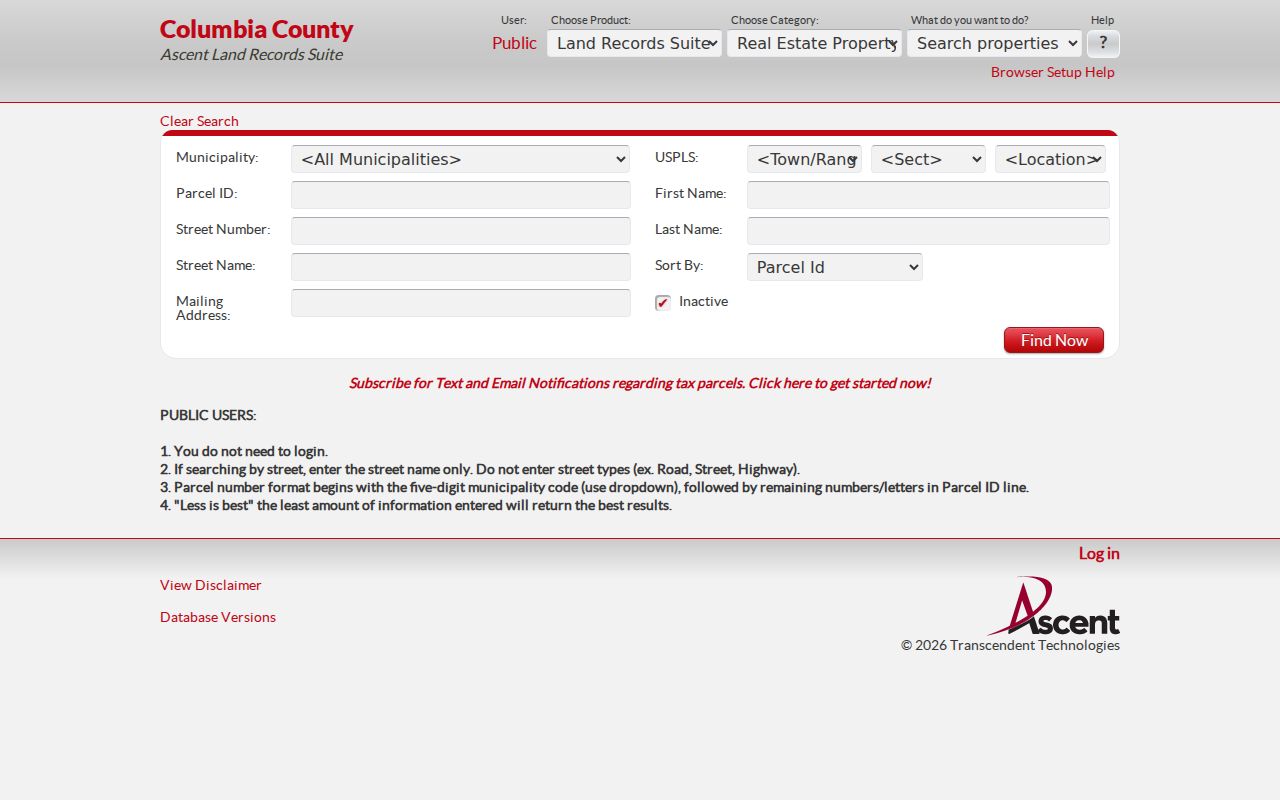
Ascent's public search screen shows the owner-lookup choices. Open a live parcel there to see its current owner field.
Check a Recent Columbia County Transfer
A new deed can be recorded well before the administrative owner field changes. The county publishes no typical lag. Put no number of days on it. Search the Register of Deeds for the latest conveyance whenever the closing date matters, and compare the grantee and legal description against the Ascent result.
The county's tract index begins in 2006. Older searches rely on the Grantor/Grantee indexes. A back-scan reaching toward December 1, 1963 is described as a project, not complete coverage. For a present-day transfer, use the newest image. Older decades need more name work.
The Ascent result also carries a privacy-expiration field and tax-year links. Neither is a deed date. Neither is an ownership-update schedule. Start with the current owner name, check the recording date on the newest instrument, and compare the full legal description before calling that party the owner. If the two systems disagree, no standard delay resolves it; ask the custodian which entry was updated last and whether a newer filing is pending.
Keep Columbia County Mailing and Situs Separate
The situs address locates the parcel. The mailing address receives the owner's tax notices. Those two can differ for ordinary reasons, such as a business address or a post-office box. The Ascent FAQ warns that a mailing-address change may not show up right away. An old notice proves little about today's owner.
Use the municipality field when postal city and taxing area seem inconsistent. The mail name is not the boundary. At city and town edges, that distinction matters most. Read a current-owner record with the parcel identifier and the deed rather than the address that feels familiar.
Read Columbia County Entity Ownership
An LLC, trust, estate, or personal representative can appear as the current owner. The roll names the party tied to the parcel. It may not name a beneficiary. Search the deed using the exact party wording. Turn to Wisconsin DFI's corporate-record search when a business entity needs checking.
DFI records can confirm an active entity or point to a registered contact. They do not establish ownership of the land. The recorded conveyance remains the evidence. A registered agent is not the parcel owner unless the deed or roll says so.
When an LLC appears in the parcel record, Wisconsin DFI corporate records can be searched by business name. Check the exact deed wording first.
Verify the Columbia County Owner Today
Confirming the current owner of record takes two Columbia County sources. Start with the assessment roll. It names the parcel's owner and gives you the parcel number to work from. Then pull the latest recorded conveyance from the Register of Deeds to see exactly how that owner took title. Check the document image, the parties, the legal description, and the parcel reference against each other. The Register's recorded documents remain the authoritative record. The office cautions that its working index can carry errors and omissions. The underlying deed image settles any doubt.
- Search the Ascent parcel by address, owner, or municipality and parcel number.
- Record the Owner(s), parcel ID, and site address from the result.
- Search the Register of Deeds for the newest conveyance and compare the named grantee and legal description.
- If an entity is named, check Wisconsin DFI records for that entity while keeping the deed as the land record.
- Owner of record
- The party named on the parcel roll for administrative purposes.
- Grantee
- The party receiving an interest in a recorded conveyance.
- Situs
- The location address assigned to the parcel.
- Mailing address
- The delivery destination associated with the owner or tax notices.
Monitor Columbia County Deed Notices
Columbia County's Register of Deeds posts a property-fraud alert signup on its real-estate page. The link is easy to spot. Signing up means you get a notice. The notice comes when something new is recorded against a parcel in Columbia County. A notice is only a prompt to look, though. It does not mean ownership changed, and it does not mean fraud occurred. When a deed notice arrives, compare the newest index entry with the recorded document itself. Use the official office contact if a record looks unfamiliar.
The county alert page carries the current signup route for recording notices.
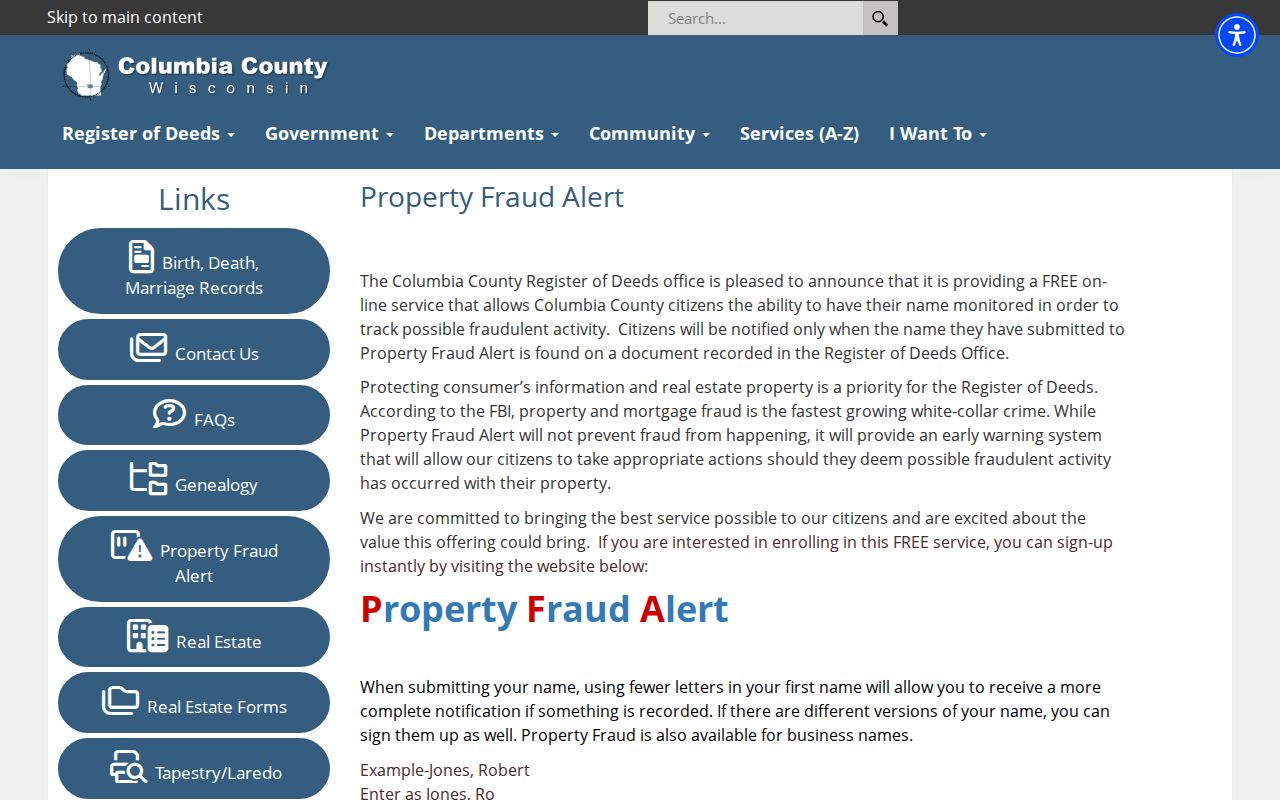
An alert can flag a recent document worth checking. Still, the recorded deed image remains the record to inspect when you want to know what actually happened with a parcel.
Use Columbia County Owner Data Carefully
A public owner-of-record entry serves property research and lawful due diligence. That is its purpose. Contacting someone at a private location for unrelated reasons is not a lawful use of Columbia County property records. Wisconsin's Safe at Home program gives protected participants a substitute address, and public agencies must follow the confidentiality rules that apply to them. Rather than trying to infer a protected address from another field, ask the record custodian which parts of a parcel entry may be disclosed.
Lawful use. Use a current owner record for a property-related purpose. Do not use a name or address to stalk, threaten, harass, or target any person.